



By Mark Gibson, PhD, PEng, PE
Senior Project Engineer
Environmental Compliance and Remediation
As temperatures begin to rise each spring, so does the potential for elevated ground-level ozone. This seasonal transition, known as the spring ozone maximum, is a well-documented atmospheric phenomenon that continues to shape air-quality management strategies today.
The arrival of warmer weather recently prompted me to revisit a study I led nearly 20 years ago in the Annapolis Valley of Nova Scotia, Canada. Often described as the “tailpipe of North America,” the rural region experiences frequent long-range transport of ground-level ozone and airborne fine-particulate matter from the Ohio Valley and the U.S. I-95 corridor. The project offered a unique opportunity to better understand how ground-level ozone behaves across a landscape heavily influenced by complex topography, coastal conditions, and seasonal meteorology.
Monitoring Ozone Across the Annapolis Valley
To evaluate how ozone concentrations varied throughout the region, I designed a year-long monitoring program using nitrite-impregnated passive ozone samplers. These small air-testing devices absorb ozone from the surrounding air over time, allowing researchers to measure pollution levels without relying on powered equipment.
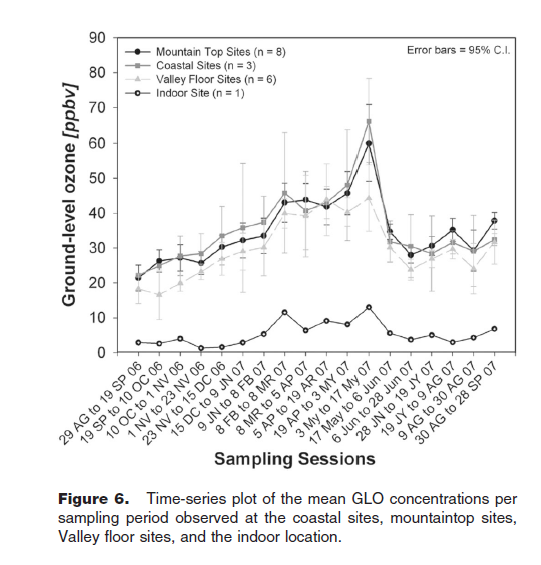
Over 13 uninterrupted months, ozone concentrations were measured at 17 outdoor locations and one indoor site spanning valley floors, mountain ridges, and coastal environments. Sampling periods lasted between two and four weeks, resulting in 353 measurements collected across all seasons. Passive samplers were also co-located with continuous analyzers to verify accuracy and precision, helping capture spatial and seasonal variations that regional monitoring networks alone often cannot resolve.
Key Findings from the Study
The monitoring program revealed several distinct ozone trends across the region, including:
- Strong seasonal and spatial ozone patterns influenced by elevation, coastal effects, and meteorological conditions
- A pronounced, valley-wide springtime ozone maximum occurring during a relatively narrow period between late April and May
- Higher ozone concentrations at elevated and coastal locations compared with valley floor sites
- Significantly lower indoor ozone concentrations, averaging roughly one-third of outdoor levels due to removal by HVAC systems and destruction on indoor surfaces
Together, these findings demonstrated how geography and atmospheric conditions can strongly influence local ozone behavior, even within relatively small geographic areas.
Why Ozone Peaks in the Spring
The seasonal behavior observed during the study aligns closely with established atmospheric chemistry principles. Ground-level ozone is considered a secondary pollutant, meaning it forms through sunlight-driven chemical reactions involving volatile organic compounds (VOCs) and nitrogen oxides (NOₓ). Common VOC sources include vegetation, paints, industrial solvents, gasoline vapors, and even perfumes, while NOₓ emissions are commonly associated with fossil fuel combustion and wildfires. In addition, a little-known fact is that lightning also contributes to the formation of NO2 in the atmosphere which also contributes to the formation of ground-level ozone.
During winter months, shorter days, weaker solar radiation, and colder temperatures suppress photochemical ozone production. As a result, ozone-forming compounds accumulate in the troposphere, the lowest layer of Earth’s atmosphere. Longer-lived atmospheric reservoir species can also accumulate during this period. With the arrival of spring, increasing sunlight, warmer temperatures, and rising biogenic VOC emissions from newly emerging vegetation rapidly accelerate photochemical activity. This combination produces the characteristic springtime ozone maximum observed across the Northern Hemisphere.
Relevance to Today’s Air-Quality Management Efforts
Although the study was conducted nearly two decades ago, the atmospheric chemistry behind ground-level ozone formation remains unchanged. Ground-level ozone continues to be a significant criteria air pollutant and short-lived climate forcer driven by NOₓ and VOC precursor emissions under warm, sunny conditions.
The same atmospheric fundamentals observed during the Annapolis Valley study continue to support the rationale behind modern U.S. EPA regulatory programs and ozone-season planning efforts. These include mobile and stationary source controls, limits on VOC content in products such as paints, adhesives, and sealants, and broader air-quality management strategies implemented through State Implementation Plans (SIPs). As ozone season ramps up each year, the findings serve as a reminder that precursor control, exposure context, topography, and sustained monitoring remain central to effective air-quality management strategies.
The lessons learned through hands-on studies like this continue to inform my work today as an air quality and air permitting and compliance specialist with KCI’s Environmental Compliance and Remediation practice. I now apply this foundational understanding to real-world regulatory compliance efforts focused on reducing ozone-forming precursor emissions across the country. The work creates a direct connection between snow-covered field sites in Canada and present-day air-quality solutions here in the United States.
To learn more about how KCI can support regulatory air permitting and compliance efforts, contact us.